Get more database and energy value with Dell PowerEdge R4715 servers and AMD EPYC processors
Countless small and midsize businesses rely on database servers to keep online retail, inventory, reservation, and back-office systems running smoothly. When success arrives in the form of growing customer counts and transaction volumes, database servers need to be able to handle greater demand. Aging server hardware can end up costing SMBs more than they anticipate through slow response times, a higher risk of service disruptions, and limited room for new applications.
Refreshing database infrastructure with new servers can improve reliability, security, speed, and scalability while reducing the cost and risk of maintaining legacy systems. But there’s a lot to consider before investing. Budget-conscious IT teams must weigh factors like purchase price, power and cooling costs, and software licensing. For organizations running SQL Server 2025 Standard Edition, which supports up to 32 cores per instance, the server choice matters too. A server that can’t use that full allowance, or one that forces a move to a pricier licensing tier, can erode the value of an upgrade over time.
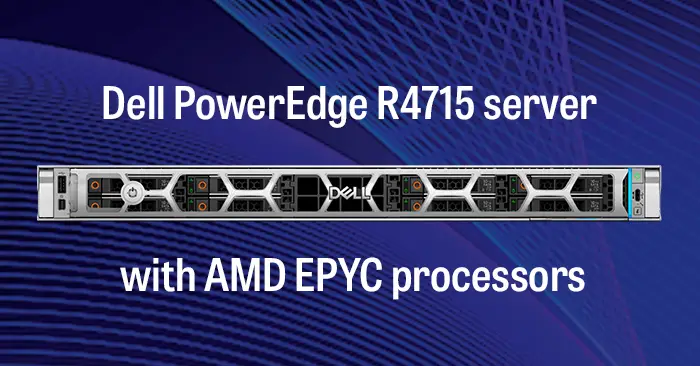
The Dell PowerEdge R4715 is a 1U, single-socket rack server built for database, virtualization, analytics, and other business-critical workloads. It supports 5th Gen AMD EPYC 9005 Series processors with up to 32 cores, along with DDR5 memory and flexible SAS, SATA, and NVMe storage options. We examined how much more database performance and efficiency buyers can expect from a new single-socket server by comparing the database performance of two configurations of the Dell PowerEdge R4715 to that of an HPE ProLiant DL320 Gen11.
How we tested SQL Server performance
We tested the online transaction processing (OLTP) performance of an HPE ProLiant DL320 Gen11 with a 16-core Intel Xeon Gold 5416S processor and two Dell PowerEdge R4715 configurations. One R4715 configuration used a 16-core AMD EPYC 9135 processor, and the other used a 32-core AMD EPYC 9335 processor and NVMe drives. The HPE system and the 16-core R4715 both used SATA SSDs.
With each server configuration, we used the industry-standard HammerDB TPROC-C benchmark to run a series of tests on SQL Server 2025 Standard and measure throughput in new orders per minute (NOPM). We also measured each server configuration’s power consumption while under test. We then calculated performance per watt and used discounted price quotes from an HPE reseller and from Dell to calculate performance per dollar for the HPE system and the 32-core R4715.
The data from our tests allowed us to assess the scalability, efficiency, and value of the PowerEdge R4715 within the SQL Server Standard licensing framework. Small businesses can thus see how much they can extend database performance without moving to a more expensive licensing tier.
What the testing found
Our tests found the following when comparing the two Dell PowerEdge R4715 configurations to the HPE ProLiant DL320 Gen11:
-
The 16-core AMD EPYC 9135 processor-powered R4715 delivered 28 percent more NOPM while using a similar amount of power.
-
The 32-core AMD EPYC 9335 processor-powered R4715 with NVMe drives delivered 2.4x the NOPM while using 31 percent more power.
-
With the 16-core processor, the R4715 delivered 25 percent more performance per watt.
-
With the 32-core processor, the R4715 delivered 87 percent more performance per watt.
-
With the 32-core processor, the R4715 with NVMe drives delivered 67 percent more performance per dollar.
What this means for SMB database operations
Refreshing your SQL Server database infrastructure with a Dell PowerEdge R4715 with AMD EPYC 9005 Series processors can help you process more customer orders, speed up inventory queries, and get more work out of each database watt and dollar. The 16-core configuration offers a solid performance boost at similar power draw to the HPE system, along with room to scale to 32 cores later as demand grows. The 32-core option lets you use SQL Server Standard Edition’s full 32-core licensing limit, so you can support growth without moving to a pricier software tier. For SMBs, a higher performance-per-watt result can deliver better value over time through stronger database responsiveness and more work per watt.
To find out more about the potential benefits of upgrading to new PowerEdge R4715 servers with AMD EPYC processors, check out the report below.


Principled Technologies is more than a name: Those two words power all we do. Our principles are our north star, determining the way we work with you, treat our staff, and run our business. And in every area, technologies drive our business, inspire us to innovate, and remind us that new approaches are always possible.


