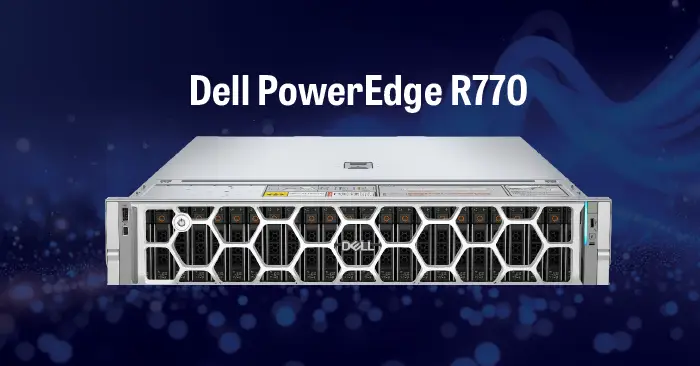
Cut SMB database costs and keep control on premises with the Dell PowerEdge R770
Every day, countless small and medium-sized businesses (SMBs), firms ranging from medical clinics to independent retailers to other professional service teams, depend on transactional database-backed applications. Those applications take orders, update inventory, record payments, and ensure smooth operations and customer satisfaction. Many of them use Microsoft SQL Server to handle online transaction processing (OLTP). For the IT teams that work to balance performance, reliability, data protection, and cost control, one decision often looms large: whether to keep their OLTP work on premises or move it to the cloud. For organizations with tighter budgets, that choice often comes down to costs over time. A sound data-driven choice needs real-world, workload-specific cost data, not just quick pricing comparisons.
We compared the transactional database performance of an on-premises Dell PowerEdge R770 server powered by Intel Xeon 6 processors to that of AWS EC2 m8i.2xlarge cloud instances handling the same SQL Server workloads, both running 24/7. To test these solutions, we ran a HammerDB TPROC-C OLTP workload on Microsoft SQL Server 2025. We then built a three-year TCO model comparing a single Dell server supporting 28 VMs against a 28-instance AWS EC2 deployment sized for comparable throughput. In our model, we accounted for server acquisition, maintenance, power and cooling, data center footprint, and cloud subscription costs.
The results showed significant performance and cost advantages for the on-premises Dell and Intel solution. Over three years, the Dell PowerEdge R770 solution we tested cost $390,031.03 less than the comparable AWS EC2 deployment, a 75 percent savings. Performance reinforced the cost story: the average VM on the Dell server delivered 36 percent higher transactions per minute and new orders per minute (NOPM) than a single cloud EC2 m8i.2xlarge instance. Across the full stack, the Dell solution delivered 5.59 times the NOPM per dollar of the AWS EC2 deployment.
Spending less on infrastructure could free SMB budgets for other IT priorities, from security improvements to backup and application modernization. In addition, keeping workloads on premises gives IT teams host-level visibility and control over their hardware and data. For SMBs refreshing database infrastructure or reevaluating cloud service spending, an on-premises Dell PowerEdge R770 solution powered by Intel Xeon 6 processors could be a smart choice for SQL Server OLTP workloads.
To learn more about our Dell PowerEdge R770 transactional database performance and TCO findings, check out the report below.


Principled Technologies is more than a name: Those two words power all we do. Our principles are our north star, determining the way we work with you, treat our staff, and run our business. And in every area, technologies drive our business, inspire us to innovate, and remind us that new approaches are always possible.


