If you’re an engineer, content creator, or developer who routinely handles data-rich, compute-intensive applications, you know that powerful mobile workstations are often the most critical workflow component for putting deadlines in the rearview mirror and moving on to the next challenge. Whether you’re running fluid dynamics simulations, rendering photoreal product assemblies, compiling a game engine, or crunching risk models, there’s always more to do--and workstations like those from the latest Dell Pro Max lineup can help you get it done.
To assess the potential benefits that the Dell Pro Max series of workstations could bring to modern resource-intensive workflows, we used both industry-standard benchmarks and real-world tasks to test the performance of a wide range of Dell Pro Max configurations against comparable HP ZBook and Lenovo ThinkPad systems. The Dell Pro Max systems we tested ranged from the discrete-GPU Pro Max 16, 16 Plus, and 18 Plus to the Premium 14- and 16-inch models and unified-memory (UMA) configurations. The UMA models trade discrete-GPU peak power for better power efficiency and battery life. For fairness, we configured the competitor ZBook and ThinkPad workstations as closely as possible to their Dell counterparts. In addition to the benchmark workloads, the real-world scenarios we tested included tasks in AutoCAD, SOLIDWORKS, CATIA, Ansys Fluent, Adobe Premiere, DaVinci Resolve, Oracle Crystal Ball, and more.
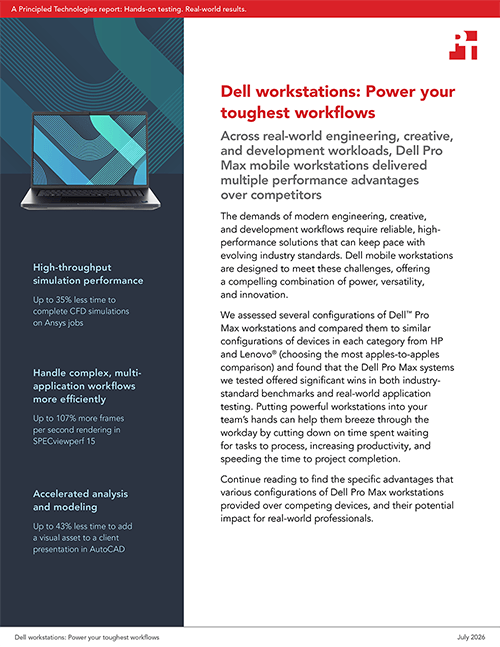
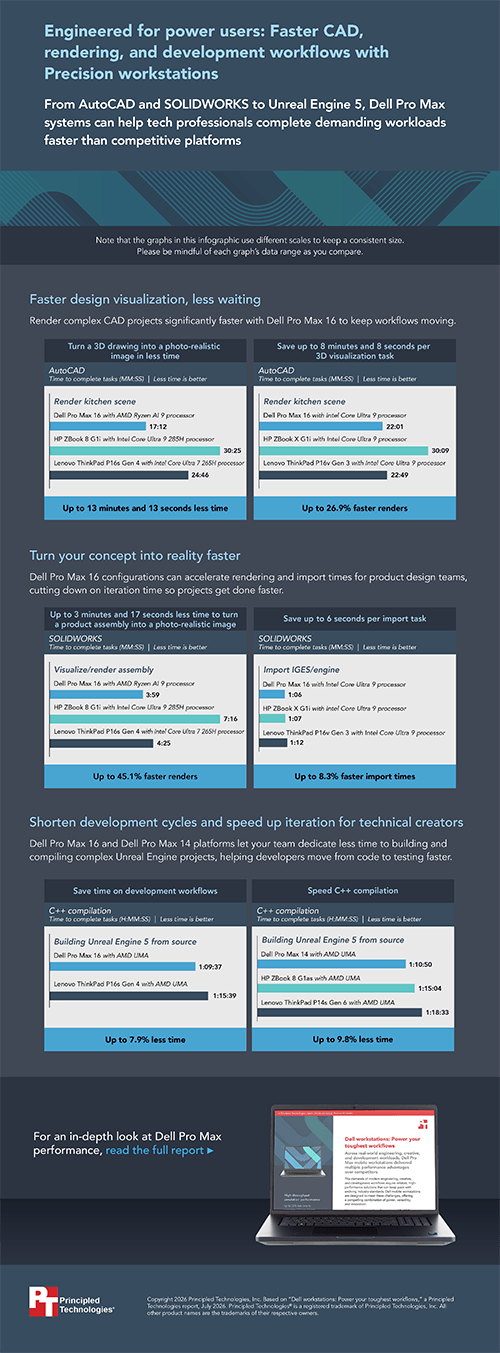
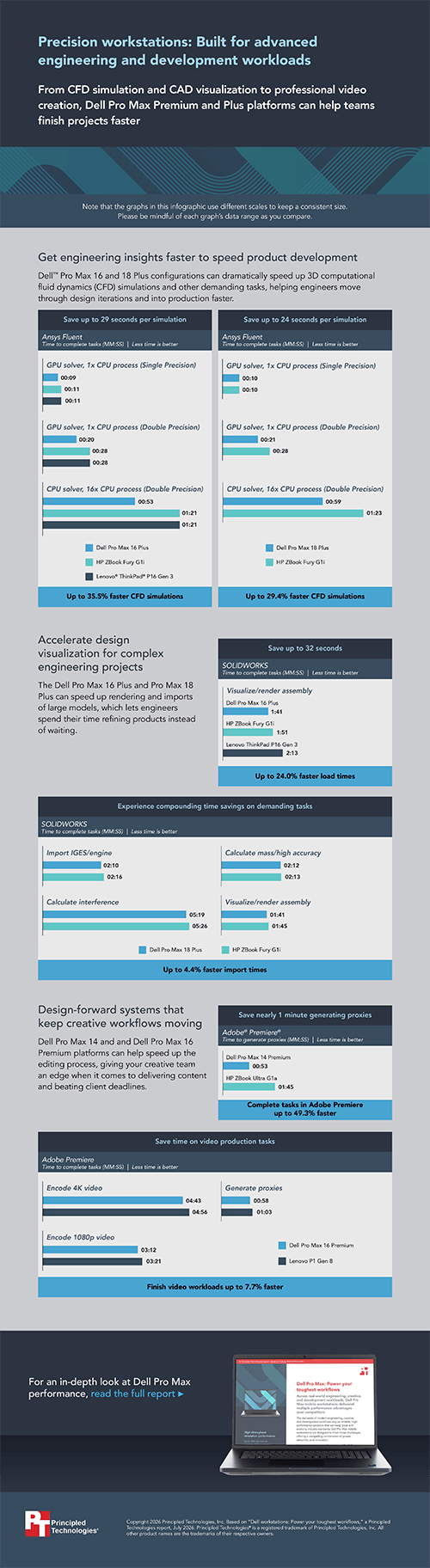
Across the board, Dell Pro Max systems delivered significant wins. The Pro Max 16 Plus ran CFD simulations in Ansys Fluent up to 35.5 percent faster than the competitor HP and Lenovo systems, and it posted up to 26.5 percent more frames per second in SPECviewperf 15. In rendering tasks, the Pro Max 16 completed an AutoCAD render up to 13 minutes and 13 seconds faster than the corresponding ZBook and ThinkPad laptops, while the Pro Max 14 Premium generated Adobe Premiere proxies in up to 49.3 percent less time than a comparable ZBook. Even the efficiency-focused UMA models led their class, with the Pro Max 14 posting up to 66.8 percent more frames per second than a comparable ThinkPad.
While the Dell Pro Max lineup’s big wins speak for themselves, the smaller wins on demanding but repetitive daily tasks—from 3D visualization to simulation to video encoding—mean less waiting, smoother iteration, and quicker project turnaround. With consistently competitive or better performance across its full range of configurations, the Dell Pro Max lineup could be a smart investment for teams that need workstation power wherever the work happens.
To find out more about our Dell Pro Max workstation comparison tests, check out the report and infographic below.


Principled Technologies is more than a name: Those two words power all we do. Our principles are our north star, determining the way we work with you, treat our staff, and run our business. And in every area, technologies drive our business, inspire us to innovate, and remind us that new approaches are always possible.


